
I led a multivariate paywall test on El Confidencial. The main question was whether a paywall without prices — followed by a dedicated landing — could convert better than the paywall with prices. The test ran with a control plus three without-prices variants. The priced paywall won. The case closed with two moves: redesign the winner with the language that worked from the losing variants, and rework the offer side itself.

El Confidencial ran a single paywall with two plans and visible prices, managed in Piano content-fields. Conversion was stable, but with no counterfactual — nobody knew whether the friction of showing price was worth the clarity, or whether a value-led paywall without price (handing checkout off to a dedicated landing) would convert better. The goal was to settle that question with a real test, not an opinion.
I benchmarked international news paywalls (NYT, FT, WaPo) and ran working sessions with the SUSC team to prioritise hypotheses. Three principles drove the design: the paywall is a decision moment, not a friction — if the user is reading, they're already engaged; price can be information, not obstacle — hiding it might read as evasion, but it had to be tested; and never put the production paywall on the line — the control keeps the majority of the traffic, always.
The control is the production paywall already shown above — visible prices, in-line checkout. Three without-prices variants ran against it, each testing a different lever before bouncing to a dedicated landing where the subscription closes: a minimal/transactional version, a social-proof version, and a value-based version highlighting the benefits of subscribing. All three share the same soft CTA — "Continue reading" instead of "Subscribe" — to test the editorial framing without the transactional pressure of the production paywall.
"Subscribe to continue reading" as a headline, "Discover the stories behind the headlines" as the only piece of value framing, and a single soft CTA. No price, no benefits list, no proof. The cleanest possible test of whether intent and the editorial promise alone can carry the user to the landing.

"Don't stop at the headline" over three reader avatars and a live counter — "X people are reading this story". Tests whether the social bias of seeing peers already inside the story shifts the decision. No price, no benefits — just the implication that other readers chose to pay for this exact piece.

"Everything your subscription includes", followed by "Discover the benefits of being an influential reader" and four benefit icons — unlimited access, exclusives, newsletters, comments. Tests whether making the value proposition explicit and visual shifts the decision more than minimal intent or social proof.

Consolidated data from production. We tested it for several weeks until the conclusion was clear. The headline read: the priced paywall won — no without-price variant moved the needle enough to replace it.
Five decisions that defined the system. Each one started as a tension with stakeholders — and ended up earning its place once the experiment had been running long enough to argue with data.
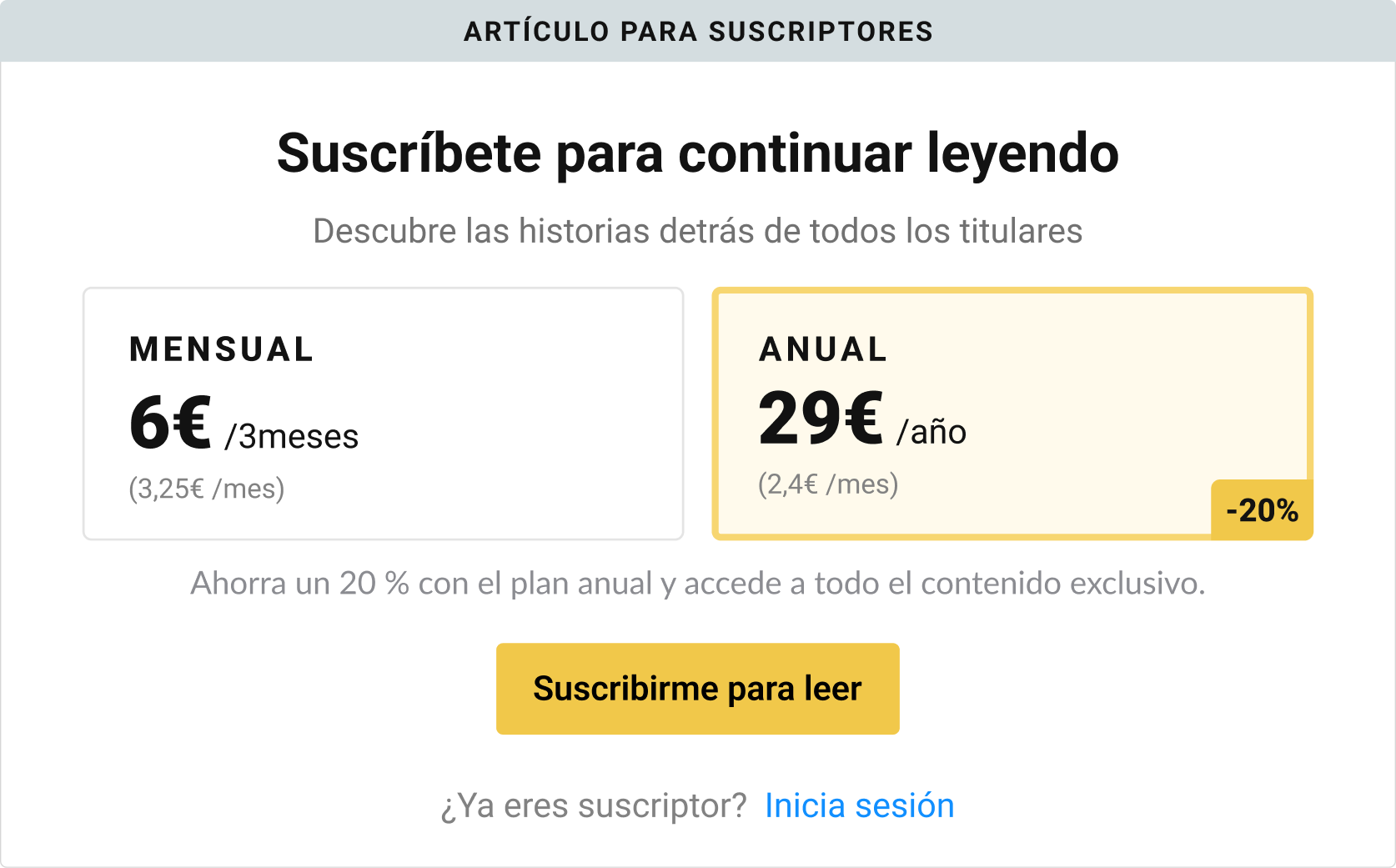
The test confirmed the priced paywall. Four changes made it into the redesign:
Aspirational headline. "Discover the stories behind the headlines" replaces "Pick the plan that fits you best".
Visual hierarchy. Annual plan highlighted with a -20% badge — the recommendation is set, not left to the user.
Per-month framing on both plans. 6€/3 months (3.25€/mo) and 29€/yr (2.4€/mo). Absolute and unit price coexist.
Action verb in the CTA. "Subscribe to read" replaces the generic "Subscribe".
The priced paywall won. That's not a failed experiment — it's a clear answer about where to push next. Without the without-prices variants in the test, the redesign of the priced paywall would have been a guess. With them, it had a real base.
The new headline on the redesigned paywall — "Discover the stories behind the headlines" — came straight from the language we tried in the value-based variants. The variants that didn't win weren't wasted: they were the source for what worked.
The three without-prices variants weren't easy to beat. Each one tried a real angle — minimal intent, social proof, explicit value. The priced paywall didn't win by being safer; it won while the others were doing their best. That made the case for keeping prices visible — and for the redesign that followed — much harder to push back against.