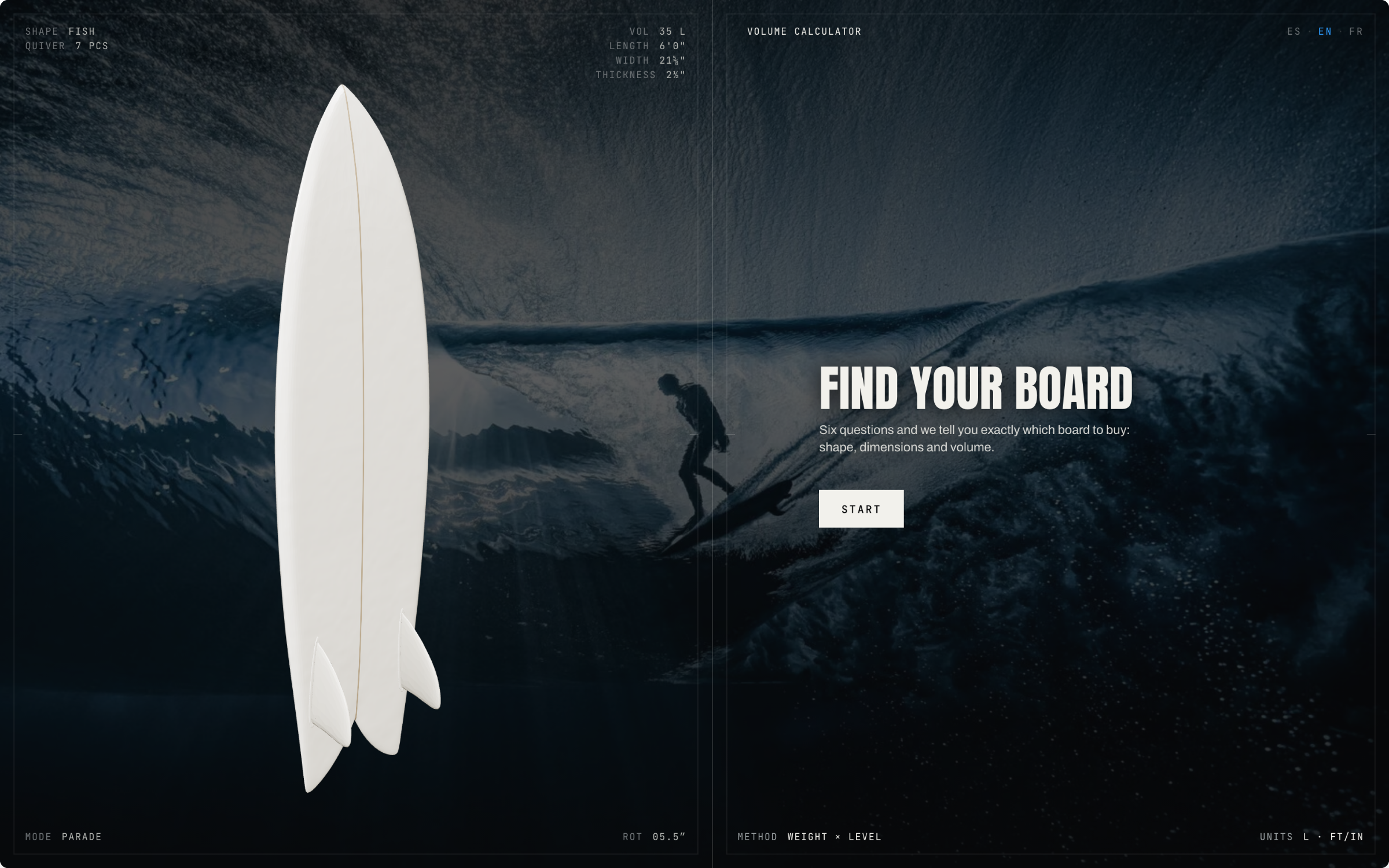
Surfboard Calculator answers a question surfers ask constantly and nobody answers the same way twice: how big a board should I buy. Six questions in, it returns a shape, real dimensions and two volume figures — one for soft waves, one for waves with power — plus the reasoning behind them and a spec you can copy and take to a shop. It has been live at surfboardcalculator.com since July 2026, and has grown into 48 pages across three languages, all generated from one route table.
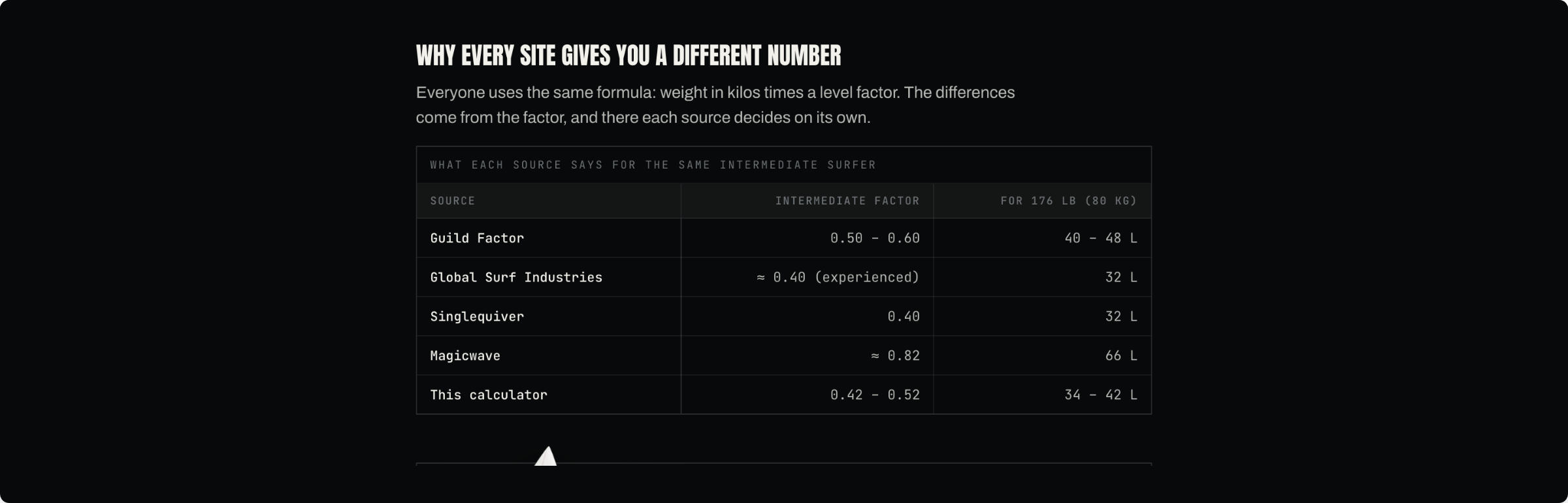
Take one surfer: 80 kg, intermediate. Ask the sites that rank for this and you get 32 litres from Singlequiver, 35 from one chart, 44 from Guild Factor and 66 from Magicwave. None of them explains why the others disagree.
They are not simply wrong. They are answering different questions — a factor for a small crumbling wave is not a factor for a head-high one, and "intermediate" means something different to each of them. So the product is not another number. It is the number plus the reason, with the disagreement laid out in public: the comparison table on the guide page puts my own calculator in the same column as the four sources it was calibrated against.
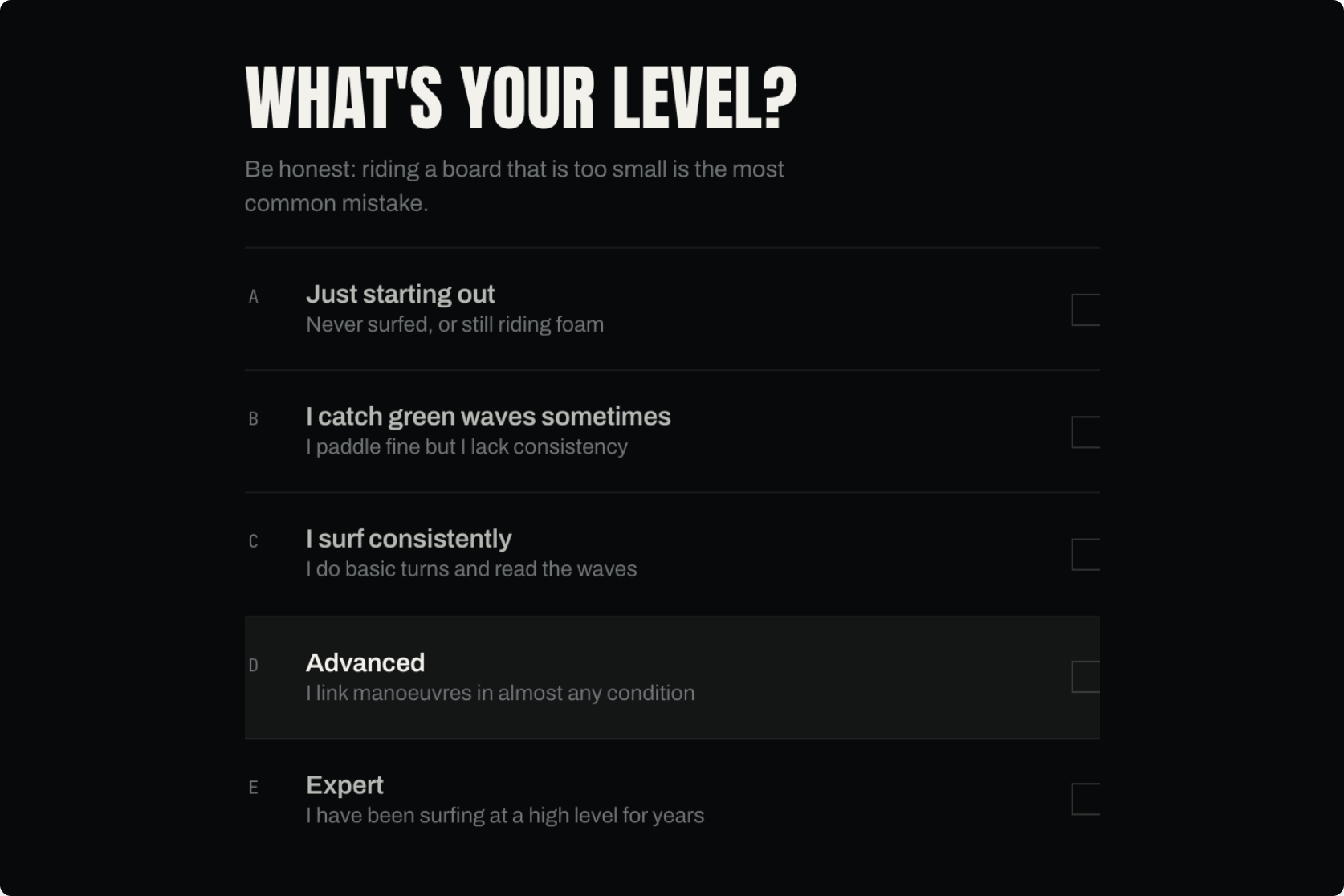
Weight, height, level, frequency, age, waves. Weight carries the calculation, height only moves the length, and age adds volume from 40 on.
The level question decides everything, so it is written to be answered honestly rather than aspirationally. The options describe behaviour instead of labels — "I catch green waves sometimes / I paddle fine but I lack consistency" — under a line that says the quiet part out loud: "Be honest: riding a board that is too small is the most common mistake." A surfer who picks "advanced" because it sounds better gets a board they cannot paddle.
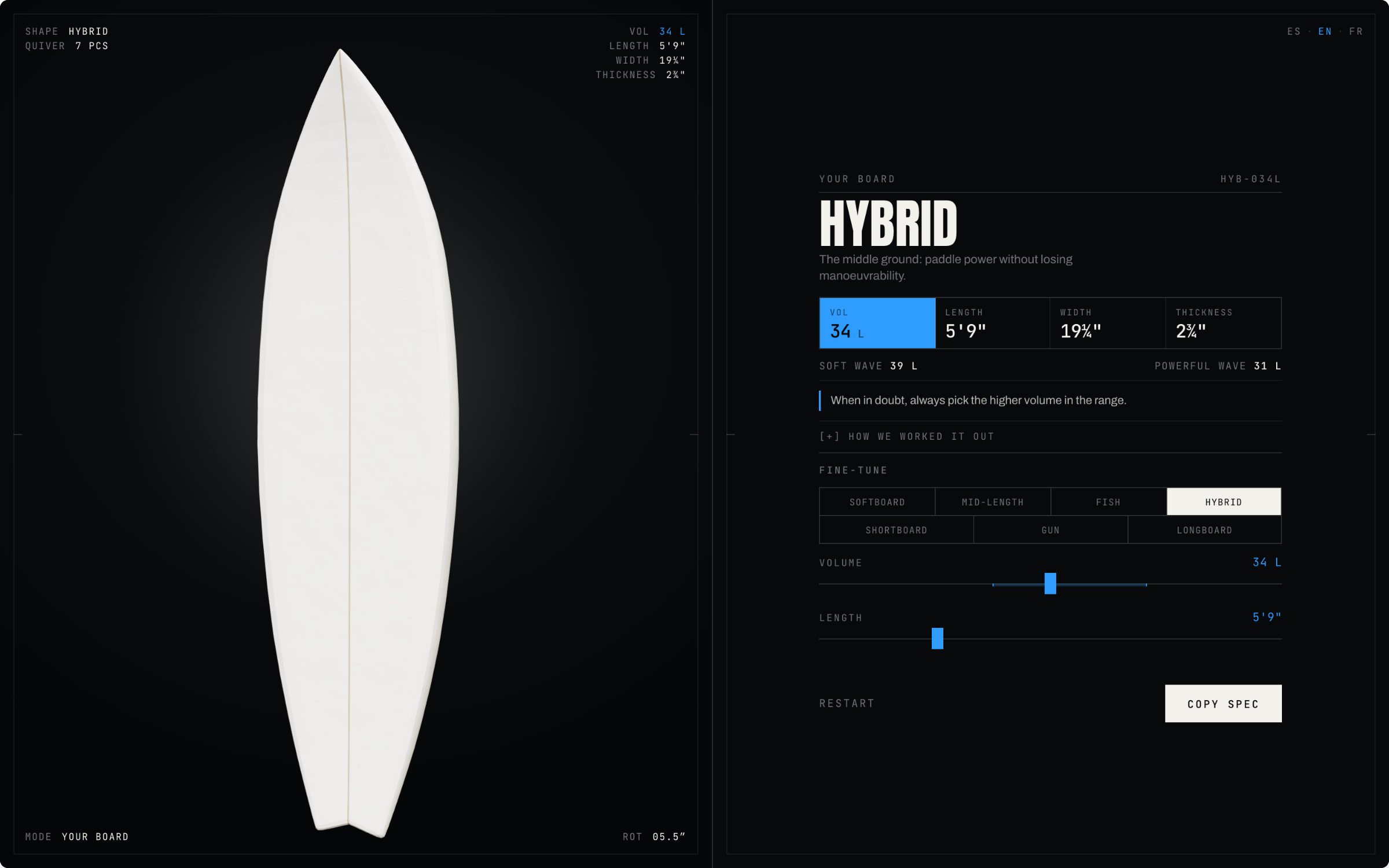
The result gives a shape, a volume, and the three dimensions a shop actually needs. The volume comes as two figures rather than one, because the same surfer needs a different board for a soft beach break than for a wave with a wall.
Everything on that screen stays editable: change the shape, push the volume, change the length, and the numbers re-derive. And the last control is the one that matters — "Copy specification", under the line "Take it to your shop or shaper." The output of this tool is a spec you walk into a shop holding.
The first concept had the board morph with every answer. I discarded it: a board that changes shape while you fill in a form reads as a toy, and it makes every intermediate state a lie.
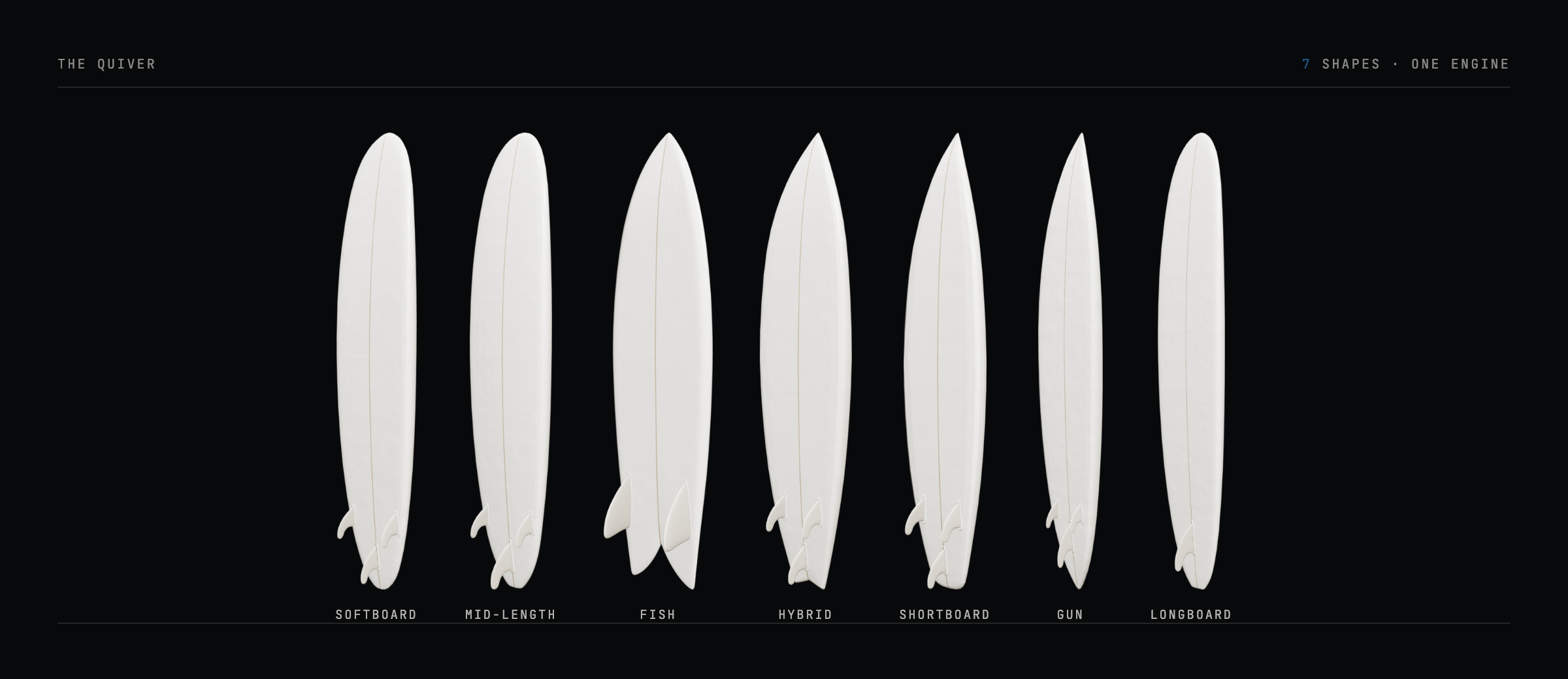
What shipped is a showroom. Seven real board models parade vertically through the intro and the six questions, each taking a full turn, and the handover hides inside a deliberate flourish — the swap lands in the fast part of the spin, where the eye does not catch it, and the incoming board arrives already at its final dimensions. Interpolating instead would make the board appear to grow during the slow part of the turn.
Forty pages of tables and charts are generated from the same engine that answers the calculator. A logic error there does not produce one wrong answer. It produces dozens of pages lying at once, signed with my name.
So before generating anything, a test walks the whole input space — every weight × height × level × waves × frequency × age, 16,800 combinations — and asserts the result is a board a human could actually ride. It caught three real faults: an intermediate in big waves handed a 7'6" funboard, volumes of 12.6 litres that no factory would make, and a beginner in big waves sent 130 litres.
The third one was fixed in copy, not in code. In big waves, what a beginner lacks is not board.
The forty-eight pages are not a content strategy. They are how I am teaching myself to rank something with content, using Search Console as the only instrument. The interesting part has been how often the data disagreed with the plan I had written.
Three decisions came out of it, and none of them is the one the plan called for.
Every figure below is from the Search Console export of 24 August 2026, twenty-six days after launch.
The next honest step is not more pages. It is the first link.
Live in production
surfboardcalculator.com
Six questions, in English, Spanish or French. No account, no cookie banner, and the reasoning is on the page.
Find your board →16,800 combinations, three real faults, one of them a beginner being sent a 130-litre board. Everything downstream — 48 pages in three languages — inherits whatever that engine says.
Five sources disagree by a factor of two on the same surfer. Putting that table on the page, with my own numbers in it, is the whole reason to trust the answer above it.
Forty-eight pages rank and almost nobody clicks, and the reason is that no site links here. Knowing which of the two problems you actually have is worth more than another month of writing.